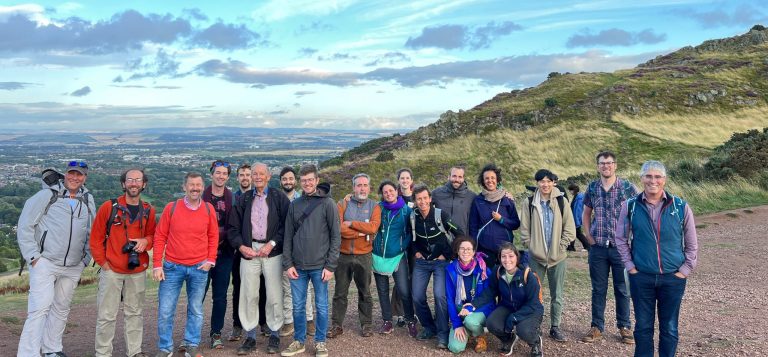

Between 23 and 25 March 2026, the GlaMBIE Consortium met with experts in different glacier observation methods to review the project’s progress. The meeting was organised by the Consortium partner LEGOS/CNRS and took place at the LEGOS facilities in Toulouse and at the Pic du Midi astronomical observatory, located at 2,877 m above sea level, which also provides workshop facilities. The observatory’s remote location allowed the Consortium to focus entirely on the project.

The workshop helped clarify several open questions related to data submission. A key topic was the choice of glacier outlines (inventories) to define the glacier reference area and the associated area-change rates. Extending the observation period within GlaMBIE-2 back to the 1970s has made this an important issue, as the linear area-change rates used in GlaMBIE-1 must now be replaced by an improved approach.

The publication strategy for both the main study and the two pilot studies, which are an integral part of the current GlaMBIE-2 project, was also reviewed. The regional pilot studies will enable more detailed analyses by (1) investigating differences between observational methods and (2) identifying ways to improve temporal and spatial resolution. These studies will address additional scientific questions while helping to develop methodologies for future GlaMBIE assessments.

Dedicated sessions also focused on the validation datasets required for both pilot studies. Participants discussed the latest developments in laser altimetry, DEM differencing, and gravimetry, as well as the systematic differences between these methods. The analyses will be carried out using specific test sites, such as Hofsjökull in Iceland. In addition, methods for combining observations with modelling and data assimilation were discussed as promising approaches for filling data gaps and comparing modelled and observational results.

A further workshop dedicated entirely to the main GlaMBIE-2 study is planned to take place online in autumn 2027. During this meeting, the submitted datasets and the preliminary results will be reviewed and discussed in detail by all participants.